If you’re a criminal looking to score big these days, you can do a lot better than black masks, smashing glass, and desperate getaways. The biggest heists of the 21st century happen through keystrokes more than crowbars, with stolen credentials instead of stolen cars.
Technology has always cut both ways – as a tool for criminals and for stopping crime. Every major advancement changes the balance between offense and defense. Generative AI is simply the latest technology disrupting that balance.
Ransomware attacks and massive data leaks may dominate headlines, but tech-assisted fraud doesn’t have to be that lofty to cost us upwards of $33.6 billion – the estimated loss from check fraud in 2025.
Now, check fraudsters are getting in on the AI revolution, making an already costly problem even more challenging. To be clear, AI isn’t replacing traditional check fraud. It’s making familiar fraud techniques more convincing, more scalable, and harder to detect.
Check fraud prevention and detection must adapt to a landscape that favors increasingly sophisticated tactics. Community banks and credit unions can start by knowing how AI is enhancing check fraud today and how it may evolve in the years ahead.
Key Takeaways
What We Know About AI and Check Fraud
While public evidence of AI-assisted check fraud remains limited, it is growing.
Recent guidance from the Federal Reserve and other industry sources shows that generative AI is already being used to facilitate check fraud in both direct and indirect ways. In some cases, AI is used to create or manipulate fraudulent checks. In others, it helps criminals build related schemes.
Here are five documented ways AI is being used for check fraud today.
AI Creates More Convincing Counterfeit Checks
Counterfeiting checks isn’t easy. Modern checks are loaded with visible and invisible security features that require advanced printing techniques and materials. High security checks are especially resistant to duplication. But with generative AI, fraudsters are closing that gap.
According to the Federal Reserve’s 2026 check fraud toolkit, criminals are using stolen information and images of legitimate checks together with AI to create truly convincing counterfeits.
Because generative AI excels at analyzing and reproducing visual patterns, it enables fraudsters to generate counterfeits that more closely resemble the real thing. Rather than inventing a new type of fraud, AI is making a familiar one much harder to detect.
AI Reconstructs Signatures More Accurately
For centuries, signature forgery required patience, practice, and a steady hand. Size, slant, pressure, and flourishes can be hard to spot – let alone replicate. Now, generative AI has dramatically lowered that barrier.
According to the Federal Reserve, criminals can extract signatures from existing documents and use AI to recreate them on fraudulent checks. As AI becomes better at recognizing and reproducing handwriting, visual signature verification may become less reliable. This is especially true of manual review where the human eye is all that stands between real and fake checks.
AI Manipulates Check Images
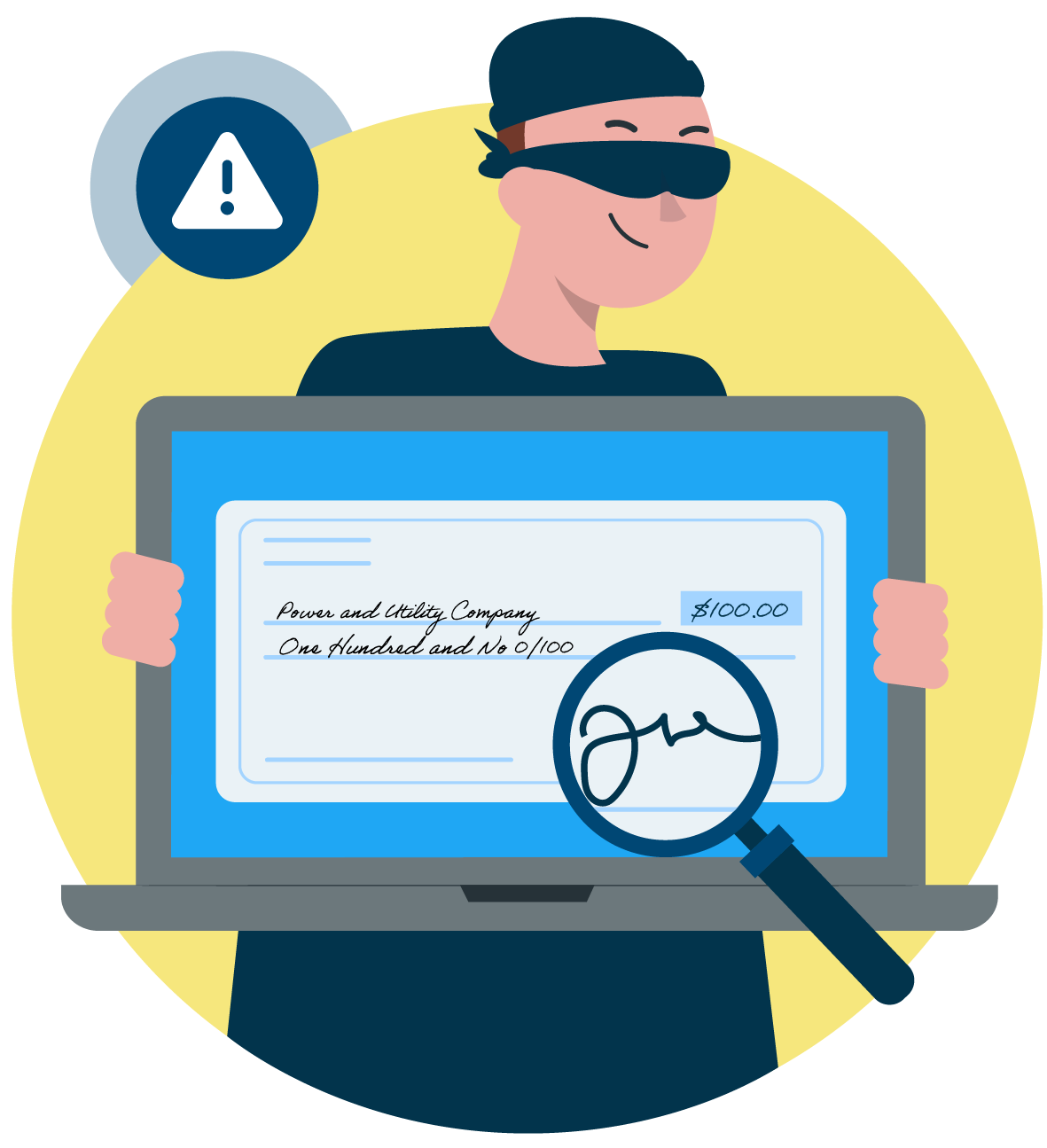
The practice of check washing traditionally relies on chemicals to remove handwritten details without damaging the check itself. Generative AI introduces a digital alternative.
Here again, the Federal Reserve is warning that criminals can manipulate images of stolen checks to reduce evidence of alteration before creating fraudulent versions.
By refining existing check images instead of building them from scratch, AI can make altered checks appear more authentic and increasingly difficult to identify through visual inspection alone. It’s easy to imagine the impacts on mobile deposits and online banking.
AI Supports Synthetic Identity Fraud
Not every AI-enabled check fraud scheme begins with a counterfeit check. Some begin with a counterfeit identity.
Synthetic identity fraud combines real and fabricated personal information to create identities capable of passing the verification process. The Financial Crimes Enforcement Network (FinCEN) reports that criminals are using AI to produce falsified identity documents, photographs, and even videos to open fraudulent accounts.
Those accounts can then be used to receive or launder proceeds from check fraud (among other crimes), expanding the infrastructure that allows these schemes to scale.

AI Automates Check Fraud Workflows
One fraudulent check can cause significant losses. Hundreds created or deposited in rapid succession present a far greater challenge.
Generative AI can automate portions of the check fraud process, allowing criminals to complete repetitive tasks more quickly and with less manual effort. By reducing the time, cost, and expertise required, AI has the potential to increase fraud’s speed and scale, potentially overwhelming our standard safeguards.
Check Fraud Prevention Must Adapt to Match Emerging Threats
Check fraud has survived every technological shift precisely because criminals adapt quickly to new tools. Financial institutions must do the same.
As AI improves, fraud prevention strategies should grow to resemble cybersecurity strategies. That means going beyond manual review by combining employee awareness, layered security controls, and modern check fraud detection software powerful enough to recognize suspicious activity at scale.
While the full impact of AI on check fraud is still being tallied, one thing is already clear: staying ahead of tomorrow’s threats means preparing for them today.
Learn More About How Check Fraud Detection Software Works
The more we know about how fraud works, the better we become at stopping it. Check fraud detection software is rising to meet the challenge by employing machine learning, handwriting analysis, and numerous other forms of early detection. See how it works and explore our dedicated check fraud software.

Sources:
Verafin. “Check Fraud’s $33.6 Billion Epicenter.” April 2026. https://verafin.com/2026/04/check-frauds-33-6-billion-epicenter/
Federal Reserve. Balancing the Risks and Benefits of Generative AI in Combating Check Fraud. FedPayments Improvement, 2026. https://fedpaymentsimprovement.org/wp-content/uploads/balancing-the-risks-and-benefits-of-generative-ai-in-combating-check-fraud.pdf
Financial Crimes Enforcement Network. Alert on Fraud Schemes Involving Deepfake Media Targeting Financial Institutions. FIN-2024-Alert004. November 13, 2024. https://www.fincen.gov/sites/default/files/shared/FinCEN-Alert-DeepFakes-Alert508FINAL.pdf