Asking for feedback can make us feel a little vulnerable. Does a new haircut really flatter us, or were they just being polite? Did we actually nail that presentation, or did we rush it? Sometimes, it’s easier to assume the best outcome than to ask hard questions.
For community financial institutions, the shortest path to meaningful improvement is feedback – especially in an age of increasing competition and evolving account holder expectations. When a question is all that separates us from meaningful changes, aren’t we better off asking the question?
Customer surveys come in all shapes and sizes – each with its own advantages, timing, and actionable insights. With a little planning, you can create, launch, and measure customer surveys for nearly any purpose. Here’s how.
Customer Satisfaction Surveys (CSAT)
Contrary to popular belief, customer satisfaction surveys aren’t meant to gauge whether an account holder likes your institution. Instead, these surveys work best when aimed at a specific interaction.
Whether they’ve opened a new account, visited a branch, or contacted support, customer satisfaction surveys provide an opportunity to gather timely feedback while the experience is still fresh.
When to Send Customer Satisfaction Surveys
Timing matters just as much as the questions you ask. Customer satisfaction surveys should be tied to recent touchpoints, giving account holders a clear experience to evaluate rather than asking for general impressions.
Consider sending a CSAT survey after:
Customer Satisfaction Survey Questions
Consider a mix of yes/no, open-ended, and rating scale questions.
Turning Feedback into Action
Customer satisfaction surveys rarely point to a single solution. Instead, they reveal where to direct your energies. If account holders consistently report confusion, long wait times, or unanswered questions, those themes may point to opportunities.
Likewise, consistently positive feedback can reinforce the practices and experiences your institution should continue delivering. The goal isn’t to react to every response – it’s to identify trends that help prioritize meaningful improvements.

Onboarding Surveys
It goes without saying that onboarding is a crucial moment. This is when new relationships are forged. Long-term loyalty and value hinge on a smooth onboarding experience, so an honest appraisal of how you’re doing here can truly pay dividends.
Onboarding surveys reveal how new account holders experience those first interactions. They show whether expectations were met and whether important information was communicated clearly. They can also uncover points of confusion before they become lasting frustrations.
When to Send Onboarding Surveys
Onboarding surveys should measure the overall onboarding journey rather than a single interaction. Give new account holders enough time to explore your products and services before asking for feedback.
Consider sending an onboarding survey after milestones such as:
Onboarding Survey Questions
Here again, you’ll want a mix of yes/no, open-ended, and rating scale questions. Focus on ease and clarity of direction.
Turning Feedback into Action
Onboarding surveys can reveal where new account holders lose momentum. If respondents consistently indicate that instructions were unclear or important information was missing, revisit the communications they received during the process.
Simple improvements such as organizing next steps into a numbered list or highlighting important details with headings or bold text can make the experience easier to follow. Small adjustments like these can help future account holders get off to a stronger start.

Net Promoter Score (NPS) Surveys
Although the concepts seem related, there’s a sizable gulf between liking something and recommending it. Net Promoter Score surveys can close that gulf by measuring long-term loyalty. Rather than asking account holders how they felt about a recent experience, they ask: How likely are you to recommend our institution to a friend, family member, or colleague?
While NPS surveys don’t always explain why someone would or wouldn’t recommend your institution, they can provide a useful benchmark for tracking customer sentiment over time. Follow-up questions can then uncover the reasons behind each response.
When to Send NPS Surveys
Unlike customer satisfaction and onboarding surveys, Net Promoter Score surveys shouldn’t be tied to a specific interaction. Instead, they work best when sent at regular intervals to measure long-term customer sentiment. Consistent timing makes it easier to identify meaningful changes over time rather than fluctuations caused by a single experience.
Consider sending an NPS survey:
NPS Survey Questions
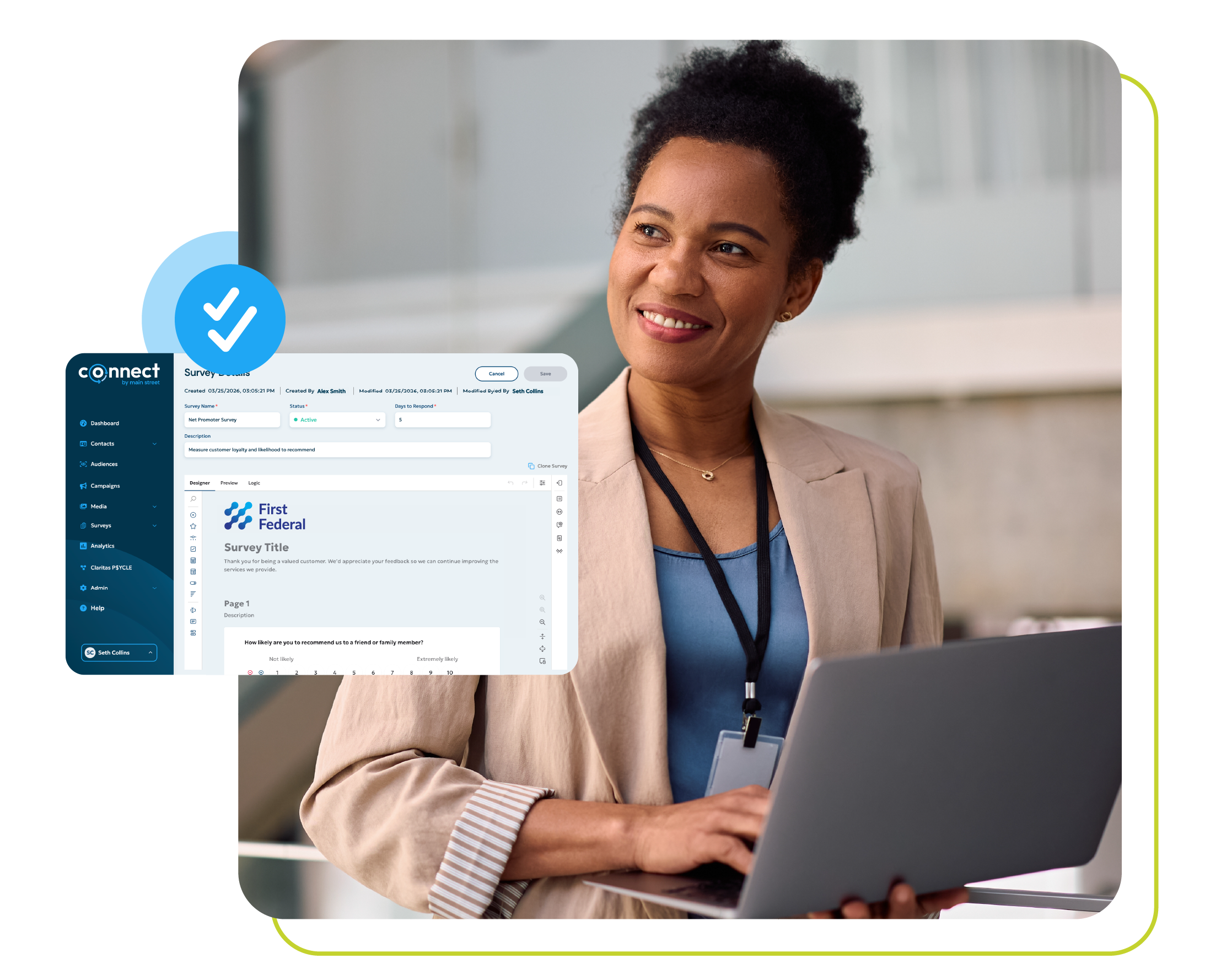
Net Promoter Score surveys are intentionally simple. Most begin with a single rating scale question, then follow up with one or two open-ended questions to better understand the reasoning behind each score.
Turning Feedback into Action
Net Promoter Score surveys separate loyal advocates from account holders who may be at risk of leaving. Study the comments behind both groups. If respondents consistently praise the same products, services, or experiences, look for opportunities to emphasize those strengths in other areas.
If recurring concerns emerge, investigate the underlying causes before deciding where to invest your time and resources. At a minimum, you’ve identified account holders who could use some extra attention. A core-integrated engagement platform can help you reach out to them directly with new offers that highlight your value.
Other Customer Surveys to Consider
The right question can reveal valuable insights at nearly every stage of the customer journey. Once you’ve established a strong survey strategy, consider expanding your efforts with surveys tailored to specific products, services, and experiences. Here are a few ideas to get you started.
Product and Service Feedback
Customer needs evolve over time, especially among younger account holders. Regular feedback can reveal how they feel about specific products and services, from checking accounts and credit cards to loans and digital banking tools.
If respondents consistently report confusion or limited awareness, consider revisiting how those offerings are introduced. Clearer descriptions, comparison charts, or educational content may help account holders better understand the value your institution provides.
Digital Experience
Whether they’re enrolling in online banking, depositing a check, or paying bills through a mobile app, account holders expect digital banking to be intuitive. Digital experience surveys can reveal where users encounter frustration.
If respondents consistently struggle with the same tasks, consider simplifying navigation, rewriting helpful content, or creating short tutorials that answer common questions before customers need to contact support.
Branch Experience
Despite the growth of digital banking, the branch experience remains an important part of many customer relationships – including Gen Z. Branch experience surveys can uncover everything from long wait times and confusing signage to exceptional service from individual employees.
If respondents consistently mention the same challenges, consider reviewing branch layouts, adjusting staffing during peak hours, or improving in-branch communications to create a more welcoming and efficient experience.
Community Programs and Events
Local involvement is one of the defining characteristics of community institutions. Surveys can measure how account holders perceive your events and outreach efforts while uncovering ideas for future programs.
If respondents consistently express interest in the same topics or activities, consider expanding those offerings. Likewise, if participation falls short of expectations, revisit your promotional efforts, event timing, or subject matter before assuming the event itself missed the mark.
Loan Experience
Applying for a loan can feel overwhelming, especially for first-time borrowers. Loan experience surveys can reveal whether applicants understood the process, received timely updates, and felt supported from application to closing.
If respondents consistently report uncertainty, revisit your loan communications. Clear application checklists, realistic timelines, and regular status updates can help borrowers feel more confident throughout the lending process.
Gather Insights & Adjust with Connect by Main Street™
Sometimes, a simple yes or no can point us in truly enlightening directions. Even in an age of data analytics and AI, human impressions and opinions matter. The right tool can make creating, sending, and measuring surveys that much easier.
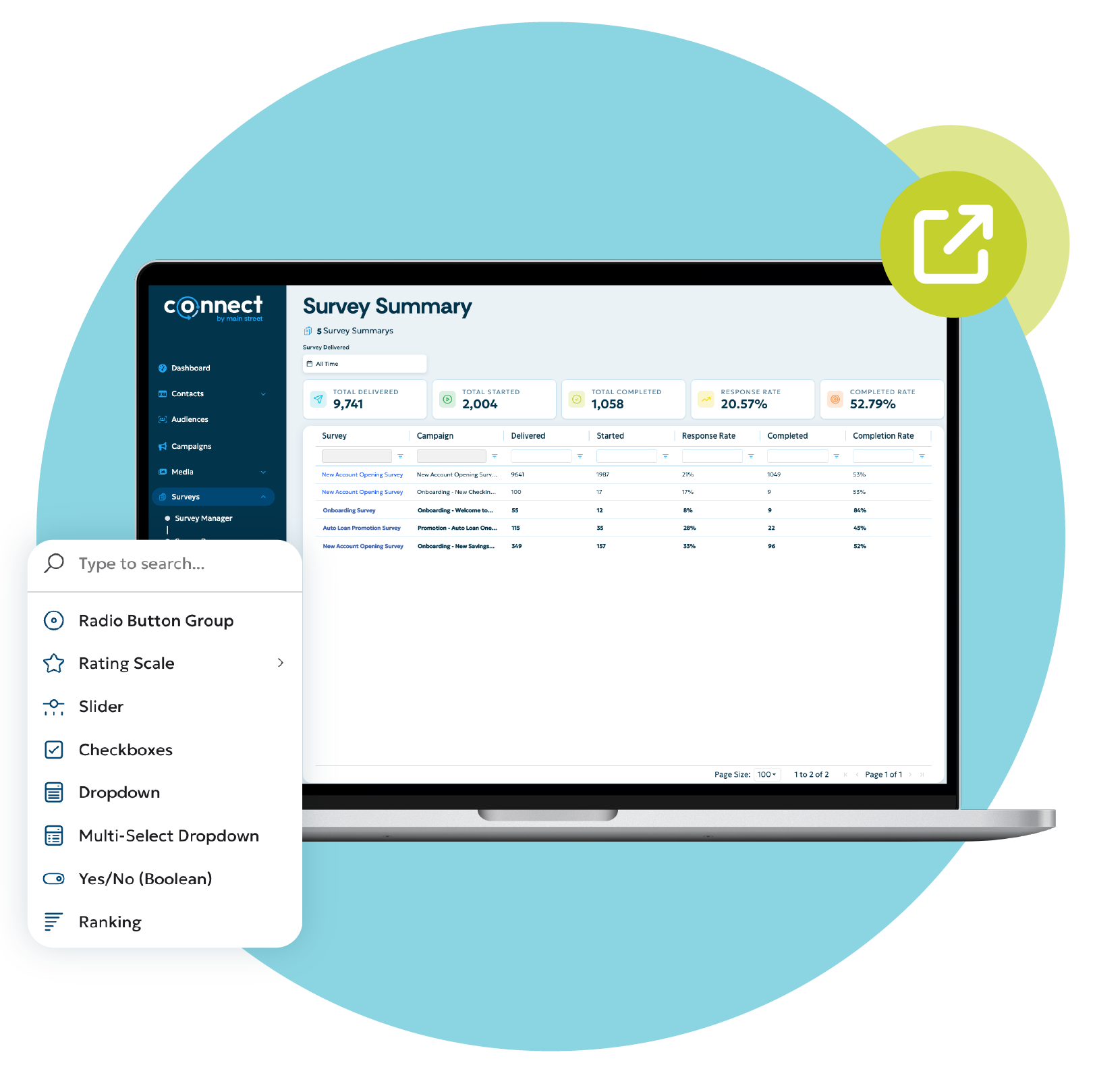
Main Street’s own marketing and engagement hub just got even better with the introduction of an all-new survey module. Choose from prebuilt surveys – CSAT, onboarding, NPS – or use our drag-and-drop builder to create custom surveys.
As a core-integrated platform, Connect makes it easier to view valuable data, launch surveys, and act on the information you collect. Get back in touch with the people that matter most and make meaningful changes to drive loyalty and satisfaction.
Learn More About Connect by Main Street's New Survey Module
As a print, email, and core-data platform rolled into one, Connect turns meaningful outreach into lasting relationships. Choose from prebuilt surveys or create your own before integrating them into emails for easy delivery. Then, view survey responses in a single dashboard to identify trends across account holder feedback. It’s just that simple.